Quick Answer
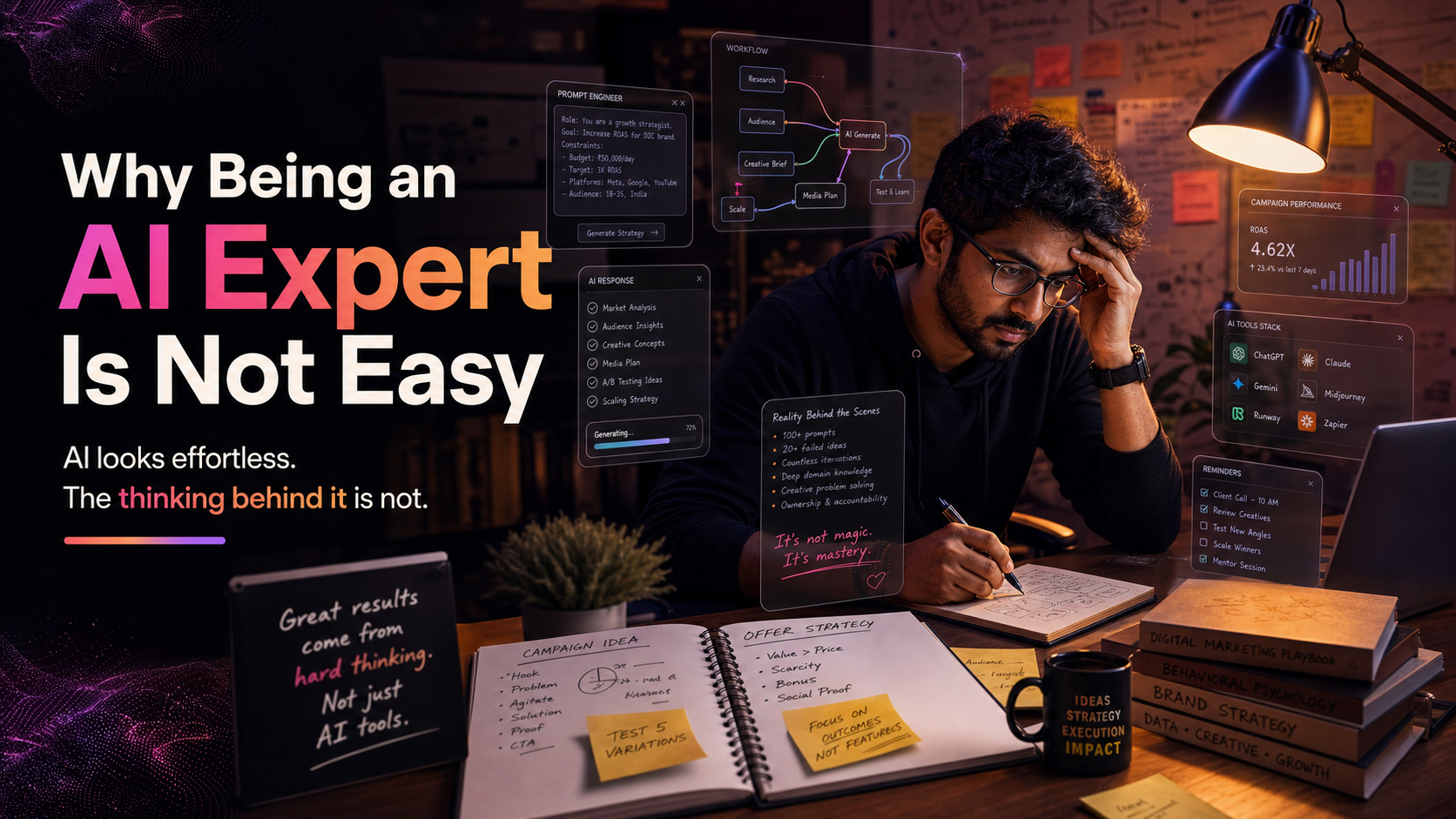
Being an AI expert is not easy because the tool does not remove thinking. It increases the speed, options, and expectations. The expert still has to understand the problem, guide the machine, review the output, fix weak work, teach people, and take responsibility for the final result.
Everyone thinks being an AI expert means we are just sitting in front of a screen, typing one magical prompt, and watching AI do the work.
From the outside, it looks smooth. We ask a question. AI gives an answer. A post appears. A workflow appears. A landing page appears. A code block appears. A strategy appears.
So people assume the work is easy.
But the truth is very different. AI may generate fast, but it does not think for you. It does not carry your judgment. It does not carry your taste. It does not carry your pressure. And it definitely does not carry your responsibility.
The Misunderstanding
People see the output. They do not see the brain stress.
People see the final app, automation, content piece, campaign, class, workflow, or video. They do not see the invisible work behind it.
They do not see the ten wrong versions before the final one. They do not see the prompt that failed. They do not see the logic that broke. They do not see the screen that looked good but made no business sense.
They do not see the moment where you stare at the output and ask the most important question: is this actually useful, or does it only look impressive?
Thinking before prompting
A good prompt is never random. It comes from knowing the problem, the person, the context, and the outcome the work must create.
Turning chaos into systems
AI gives pieces. The expert connects those pieces into a workflow, app, content engine, campaign, lesson, or decision system.
Protecting taste
AI can make average work look polished. The expert has to know when the output is actually good and when it only looks good.
Teaching humans, not tools
A creator, coach, and mentor has to handle confusion, fear, excitement, ego, doubt, and expectations. That is emotional work too.
Creator Reality
As a creator, coach, and mentor, AI work is mental work
As a creator, I am not just trying to produce more. I am trying to produce work that has a point. That means I have to protect the idea from becoming generic.
As a coach, I am not just showing people tools. I am helping them think. I have to take their confusion, fear, excitement, and overconfidence and turn it into a learning path they can actually follow.
As a mentor, I am not just answering questions. I am watching how someone thinks, where they get stuck, where they rush, where they avoid details, and where they need confidence.
That is why AI expertise is not just a technical skill. It is a thinking skill. It is also an emotional skill.
The Pressure
AI makes the work faster, but it also raises the expectation
The strange thing about AI is that speed creates a new kind of pressure. When people know you can move faster, they expect more. When they know you can create more, they expect better. When they know you can build with AI, they assume every complex thing should become simple.
The Real Skill
The hardest part is managing your own mind while using AI
AI can overwhelm you with possibilities. It can give ten directions when you only need one. It can make wrong answers sound confident. It can make average ideas look polished.
That is why the expert has to stay calm. You need to know what you are building, who it is for, what success looks like, and which output deserves your attention.
The real skill is not typing prompts. The real skill is turning noise into direction.
Creativity is not automatic. Taste is not automatic. Judgment is not automatic. Leadership is not automatic. These are human skills, and AI makes them more important, not less.
Teaching AI
The goal is not to let AI do everything
When I mentor people, I do not teach them to become lazy with AI. I teach them to become sharper with AI.
The goal is not to say, "AI will do it." The goal is to ask, "How do I lead AI toward the right result?"
That one shift changes everything. You stop depending on the tool blindly. You start directing it. You start questioning it. You start improving it. You start using it as a partner, not as a replacement for your brain.
A Honest Note
Some days AI feels magical. Some days it feels messy.
Some days, AI feels like magic. You get the right idea, the right structure, the right workflow, and the right draft in minutes.
Some days, AI feels like a confusing machine throwing unfinished thoughts at you. You have to correct it, simplify it, rebuild it, test it, and sometimes throw the whole answer away.
And on both days, the expert has to stay steady. That is the invisible skill most people do not see.
AI does not replace the expert. It exposes the expert.
If you want to learn AI seriously, do not only learn tools. Learn how to think, decide, create, test, explain, and lead the machine toward something useful.
Learn AI With EugeneFAQ
Why Being an AI Expert Is Not Easy FAQs
Is being an AI expert easy?+
No. Using AI tools can be easy, but being an AI expert is not. The expert has to understand the problem, design the right prompt or workflow, review the output, fix errors, protect quality, and take responsibility for the final result.
Why do people think AI experts are just vibing?+
People usually see the final output, not the thinking behind it. They see the app, automation, post, campaign, or training session after it is polished. They do not see the failed versions, debugging, decision-making, and mental pressure behind the scenes.
What is the hardest part of working with AI?+
The hardest part is managing your own mind while using AI. AI can produce too many ideas, confident mistakes, and polished but weak answers. The expert must stay calm, ask better questions, and keep moving toward the right outcome.
What skills does a real AI expert need?+
A real AI expert needs creativity, business understanding, technical judgment, communication, workflow thinking, prompt design, testing discipline, and the ability to teach people how to think with AI instead of blindly depending on it.